
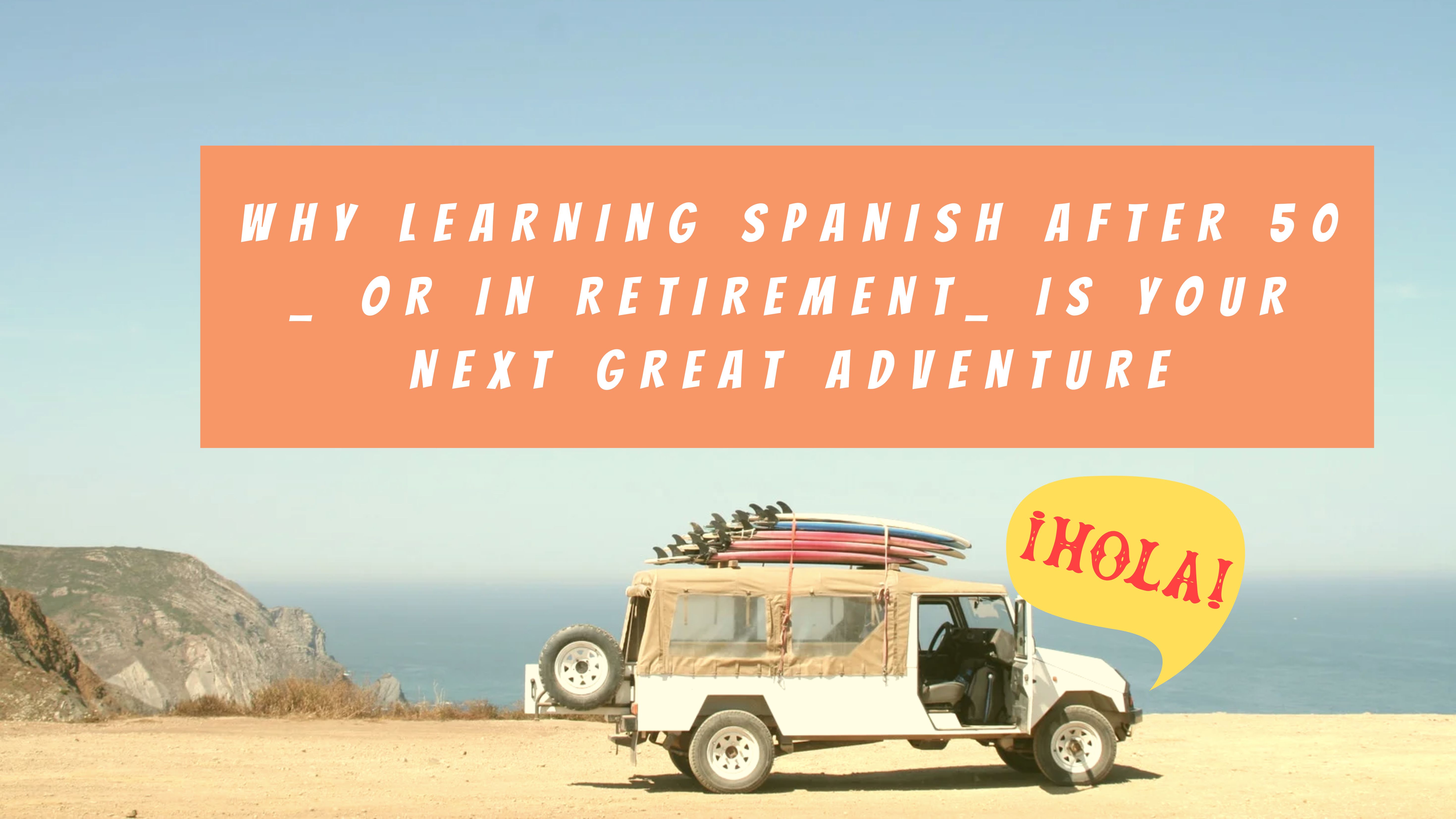
Who said adventures are only for the young?
If anything, this stage of life is the perfect moment to open new doors, stretch your mind, and bring more joy into your days. Learning Spanish does exactly that, and then some.
Because after 50, you finally have something you didn’t have before: time for yourself. Time to learn without pressure, without exams, without rushing from one obligation to another. Time to savor small victories. Time to follow your own pace.
But the benefits go far beyond “just a hobby.” Science suggests learning Spanish (or any new language) at this stage can be a powerful catalyst for mental, emotional, social — even neurological — wellbeing.
1. A brain that stays sharp, active and curious
- A long-term study of people born in 1936, tested in childhood (age 11) and then again in their early 70s, found that those who spoke more than one language, even if they learned the second language in adulthood, scored significantly better on general intelligence and reading tests than would be expected from their childhood baseline. newsroom.wiley.com+1
- A 2025 large-scale review of over 11,000 older individuals (aged 59–86) found that those who learned more languages, even later in life, performed better across cognitive tasks including working memory, attention, and processing speed. OUP Academic+1
- A randomized controlled trial with older adults (65–75) who took foreign-language lessons for 6 months showed improved overall cognitive abilities, gains that held up months after the course ended. PubMed
- More broadly, a recent review of neuroimaging and cognitive studies concluded that second-language learning in later life is associated with strengthened neural networks, improved working memory, better attention control, and increased functional connectivity in the brain. PubMed
In short: neuroscience says that learning a language later in life isn’t futile. It’s one of the smartest ways to keep your brain exercised, challenged, and growing. The brain doesn’t “switch off” , learning helps maintain, reshape, and even expand it.
2. Travel experiences that feel richer and more meaningful
When you speak Spanish, every trip to a Spanish-speaking country transforms. It’s not just about ordering food or asking for directions, you begin to connect on a human level: reading signs on your own, chatting with locals, understanding jokes, recognizing the rhythm and soul of a place.
No more tourist-only experience. You start to truly feel like a visitor who belongs.
3. New friendships and connections — even online
Learning Spanish opens doors to meet new people: fellow learners, native speakers, fellow retirees. Whether via conversation groups, online forums, social media or travel: language equals connection.
For many, these connections become meaningful friendships rooted in shared curiosity and mutual respect. It’s not just a language you learn, it’s a community you join.
4. A sense of achievement, purpose and renewed confidence
When you decide to “go for it”, to learn something new, different, challenging, you inject fresh purpose into your daily rhythm.
You get to celebrate small wins: after weeks of vocabulary, you understand your first Spanish sentence. After months of grammar, you respond in real conversation. That feeling? It matters. It lights you up.
For someone retired, it’s more than a pastime. It’s growth. It’s progress. It’s your next personal project.
5. Learning more than a language: a door to other cultures, perspectives and ways of living
Spanish isn’t just grammar and vocabulary. It’s music in the words. It’s history, literature, traditions, expressions that carry personal and collective experiences.
With Spanish, you can read poetry, follow cinema, enjoy music, converse about everyday life or deeper ideas. You broaden not just what you say, but how you see the world.
✅ Why now is the perfect time (it’s never “too late”)
- Research supports that the later in life you start learning does not eliminate benefits. newsroom.wiley.com+2OUP Academic+2
- Your brain — even older — remains plastic. Engaging it with a challenging, enriching activity like language learning stimulates new connections and preserves mental agility. PubMed+2PubMed+2
- For many retirees or people 50+, life offers something priceless: time and freedom. Without the rush of daily obligations, you can bet on consistency — and consistency is key to language progress.
So if you are 50+… in your 60s, 70s, 80s or even 100, this is not “too late.”
This is exactly the right time.
✨ Ready for your Spanish adventure?
Start with one simple “hola.”
👉 Book your free trial lesson with me, and let’s create a personalised learning path that fits your goals, your pace, and your interests.